Millions of us regularly solve Sudoku puzzles.
In this lecture, the mathematics behind them was discussed, and the links to other kinds of number grids, like magic squares and so-called Latin squares, which have been studied for centuries. Latin squares have many applications in areas as diverse as experiment design, algebra and coding theory.
https://www.gresham.ac.uk/sites/default/files/transcript/2023-11-21_1300_Hart-T%20%28PDF%29.pdf
References and Further Reading
- Robin Wilson’s How to Solve Sudoku, published by Brilliant Books, ISBN 9781904902621.
- You can read about antimagic squares at https://mathworld.wolfram.com/AntimagicSquare.html
- There’s a very interesting paper about the ancient order 4 magic square we mentioned
Varāhamihira’s pandiagonal magic square of the order four, by Takao Hayashi
https://www.sciencedirect.com/science/article/pii/031508608790019X
- See Fermat’s magic cube: https://demonstrations.wolfram.com/FermatsMagicCube/
- The Numberphile video on magic hexagons is at https://youtu.be/ZkVSRwFWjy0
- You can read the gory details about the minimum number of entries in a valid Sudoku puzzle in the paper There is no 16-Clue Sudoku: Solving the Sudoku Minimum Number of Clues Problem via Hitting Set Enumeration, by Gary McGuire, Bastian Tugemann, Gilles Civario at https://arxiv.org/pdf/1201.0749.pdf
- Latest update on magic squares of order 6 is at https://magicsquare6.net/doku.php?id=magicsquare6
- Professor Hart made her magic Sudoku with the help of https://www.sudoku-solutions.com/, which checks any partial grid you enter to see if it is valid and has a unique solution. So you can (try to) make your own, subject to whatever crazy constraints you like.
- If you want to get a lot further into more of the mathematics relating to Sudoku, try Taking Sudoku Seriously: The math behind the world’s most popular pencil puzzle, by Jason Rosenhouse and Laura Taalman (Oxford University Press, 2011).
A note on images used in the lecture
To the best of Professor Hart’s knowledge all the images used are either in the public domain, or may be used for educational purposes under fair use rules, or were created by me. The only image she wasn’t able to source definitively was the photograph of the Latin square laid out in 1929 at Beddgelert Forest in Wales; She believes it’s from a Forestry Commission report of circa 1945.
Professor Sarah Hart
- Professor of Geometry (2020 – )
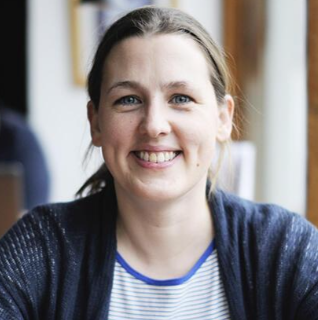
Sarah Hart is the first woman Professor of Geometry at Gresham College, and was appointed in 2020. She is Professor Emerita of Mathematics at Birkbeck, University of London.
She studied at Oxford and Manchester, gaining her PhD in 2000. Postdoctoral research and teaching followed, including a prestigious Engineering and Physical Sciences Research Council Fellowship, before she was appointed to a lectureship at Birkbeck in 2004. She became Professor of Mathematics there in 2013, and served in various management roles including as Head of Mathematics and Statistics, Assistant Dean, and Programme Director for the MSc Mathematics.
Her academic publications have been mainly in the area of pure mathematics known as group theory, which has many applications both inside and outside of mathematics, for example in coding theory and cryptography. She is actively involved in the British Society for the History of Mathematics, and has served a three-year term as President of the Society from 2021-2023.
Professor Hart is passionate about communicating mathematics and is a sought-after public speaker. She is particularly interested in the links between mathematics, culture and creativity: many of her public lectures and talks in schools relate to these topics. Her book Once Upon a Prime: the Wondrous Connections between Mathematics and Literature, was published in 2023, and has been positively reviewed in the press, including The Sunday Times, The Observer, The Economist, The New York Times, The Washington Post and the Wall Street Journal.

 helen the hare