14 Apr 2026
Chris Sinclair talks to Michael Frayn about a revival of his classic science play Copenhagen, directed by Michael Longhurst
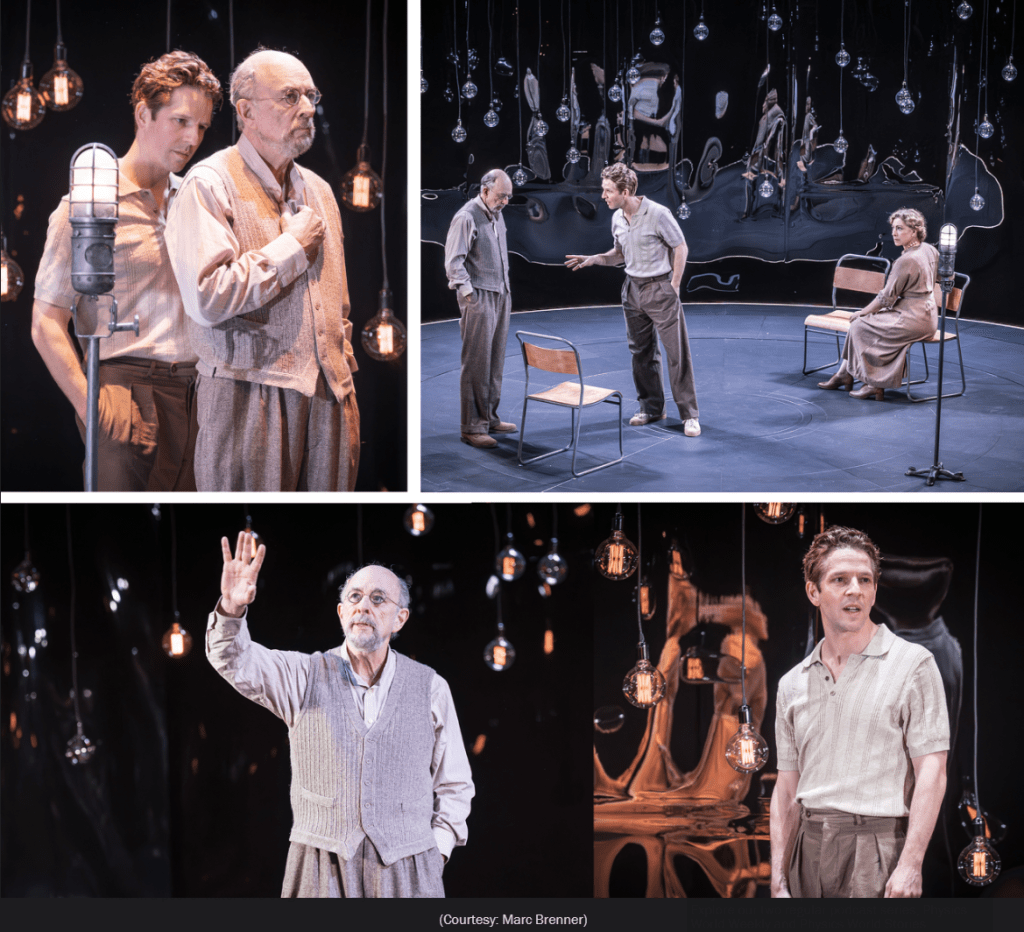
Stage success Damien Molony (as Werner Heisenberg), Richard Schiff (Niels Bohr – with cardigan) and Alex Kingston (Margrethe Bohr) in the revival of Michael Frayn’s Copenhagen at the Hampstead Theatre in London. (Courtesy: Marc Brenner)
When Werner Heisenberg retreated at daybreak to an isolated rock on the island of Helgoland in June 1925 to contemplate his development of quantum physics, he might well have been surprised to know that this moment would be recreated by an actor perched on the back of a chair in a pool of water on a stage over 100 years later.
However, this is exactly what happens in a revival of Michael Frayn’s play Copenhagen, currently at Hampstead Theatre in London.
The play explores Heisenberg’s visit to see Niels Bohr in Nazi-occupied Copenhagen in 1941 and features just three characters, Heisenberg, Bohr and Bohr’s wife Margrethe. The intentions surrounding Heisenberg’s visit have always been unclear, with this uncertainty being central to the play, which was first staged to critical and popular acclaim at the National Theatre, London, in 1998.
The initial success of Copenhagen came even as a surprise to its writer Michael Frayn. “When I wrote it, I didn’t think it would even be staged,” he admitted in an interview with Physics World. Eventually, Copenhagen went on to receive many accolades, including a Tony Award for Best Play and enjoyed over 300 performances in London and New York.
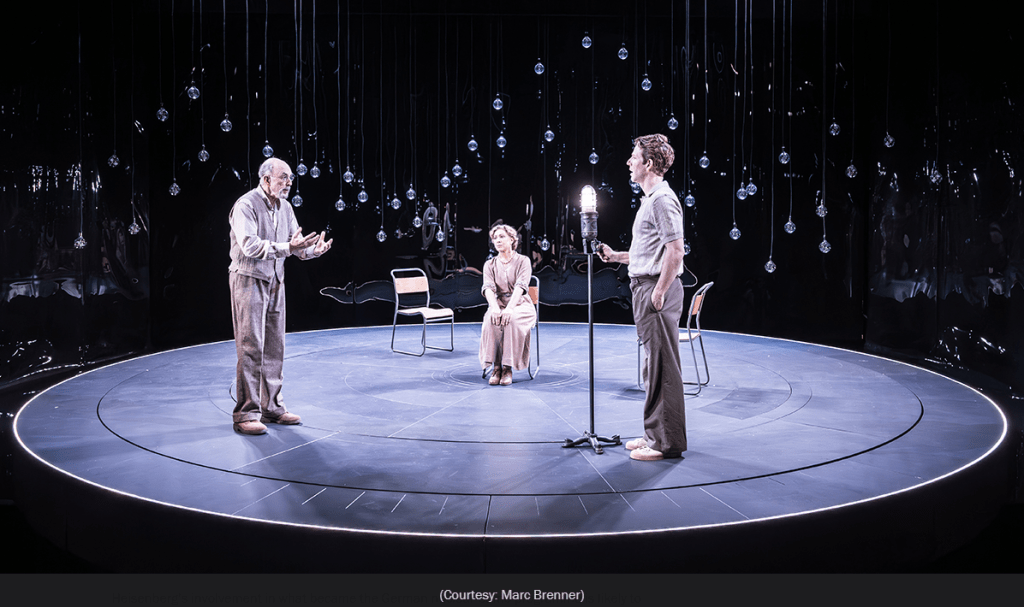
Round and round The revival of Copenhagen, which focuses on the 1941 discussion between Niels Bohr (left) and Werner Heisenberg (right), with Margethe Bohr looking on. (Courtesy: Marc Brenner)
Heisenberg’s involvement in what became the German nuclear-bomb programme is likely to have been a significant factor in his seeking to meet with Bohr, but the beauty of the play is the uncertainty behind the real motivation for the meeting.
As Frayn told Physics World: “The play is about the elusiveness of human intention, so I don’t claim to have a settled view of Heisenberg’s.”
However, Frayn hints that he is most persuaded by Heisenberg’s own account, which he gave many years later, that he wanted to warn the Allies about Germany’s plan to build a bomb, rather than trying to get information from Bohr to help the Nazi programme.
Bohr’s confirmation in his unsent letter [in 1957],” says Frayn, “that Heisenberg had in fact overridden all normal obligations of wartime secrecy to tell him that Germany was doing research on a nuclear weapon – and that he now believed it was in theory possible to build one – seems to me to go some way to reinforcing the account that Heisenberg himself gave later of his intentions in seeking the meeting in 1941.”
As for the new revival at Hampstead, Longhurst says it is a chance “to engage with an incredible play that hasn’t been seen in London since that original production”.
“I’m very proud of the cast that we’ve assembled in Damien Molony, Richard Schiff and Alex Kingston, who I think are individually and collectively brilliant. I guess what is thrilling about the play when you see it live, and it is three bodies in a contained space, is watching them shift between prosecutor, witness and judge. That triangle of relationships is constantly shifting. I like to imagine them as three entangled souls with an unanswered question.”
- Copenhagen runs at Hampstead Theatre, London, UK until 2 May.
Chris Sinclair is a physicist in the UK, who runs Science Centre Stage, which supports the depiction of scientific ideas and the history of science in theatre
This article was published by the Institute of Physics on the 14th April 2026
Secret letters cast light on Copenhagen
05 Nov 2001 Matin Durrani
Letters by Niels Bohr that have been kept secret since his death could explain the mystery of why Werner Heisenberg visited him in Copenhagen in 1941
When the author Michael Frayn spent two years writing Copenhagen, he had no idea how successful the play would become. He doubted that audiences would sit through a historical drama about a war-time meeting between Werner Heisenberg – head of Germany’s nuclear programme – and his old mentor Niels Bohr in the Nazi-occupied Danish capital in 1941. But Frayn’s efforts paid off. Audiences and critics alike have thrilled at the way the award-winning play probes the historical uncertainty that surrounds the encounter.
Was Heisenberg fishing for information about the Allies’ atomic plans – or was he trying to recruit Bohr for Germany’s bomb programme? Did Heisenberg want to suggest that the Germans were close to finishing a bomb so that the Allies would make peace with Hitler? Maybe he was simply seeking approval from Bohr for his own atomic work. There is also a moral debate: did Heisenberg know how to build a bomb, but decided not to – or did he want to build one, but got his calculations wrong?
Unfortunately, no-one was there to record or observe the encounter and we cannot know for sure what was said or implied between the two men. All we do know is that the pair dined together and took a short walk – and that the incident damaged Bohr and Heisenberg’s friendship forever. To piece together what happened, historians of science have had to rely on Heisenberg’s post-war recollections – which have been ambiguous and contradictory – along with scraps of evidence from secondary sources.
History and reality
Now, however, new light could be shed on the meeting following a decision by the family of Niels Bohr to release previously secret documents that he either wrote or dictated to others about the meeting. A total of 11 documents will be released, including various attempts that Bohr made to formulate letters to Heisenberg about what happened in 1941. Bohr was a stickler for writing down everything he worked on, and he may not have intended to send the drafts at all.
The documents have until now been locked up in the vaults of the Niels Bohr Archive in Copenhagen, where they have been accessible only to members of the Bohr family. Finn Aaserud, director of the archive, is part of a group who will transcribe Bohr’s notoriously difficult handwriting and translate the Danish into English. He plans to have the documents ready by the end of this year.
The decision to release the material was announced at a conference on drama and the history of science that was held in Copenhagen at the end of September, exactly 60 years after the war-time meeting. The Bohr family originally intended to release the documents in 2012 – 50 years after Bohr died – but they hope that doing so now will avoid any further “misunderstandings regarding their contents”.
One controversy concerns the suggestion, first proposed by the journalist Robert Jungk in his 1958 book Brighter Than a Thousand Suns, that Heisenberg submitted a secret plan to Bohr at the meeting. The plan, Jungk claims, was to prevent the development of an atomic bomb through a mutual agreement between German and Allied physicists. Jungk’s assertion, which Heisenberg repeated in several of his own post-war accounts of the meeting, implies that the building of a bomb was a moral issue for Heisenberg.
That no such plan came to pass could be interpreted as a failure on Bohr’s part. Indeed, the characters in Frayn’s play – Bohr, Heisenberg and Bohr’s wife Margrethe – debate the fact that Bohr later worked on the Manhattan atomic-bomb project, which led to the deaths of thousands of people, whereas Heisenberg did not contribute to the loss of a single life.
Aaserud, however, believes that the documents will confirm what Aage Bohr briefly noted in a paper in 1963 about his father’s war years. “According to Aage Bohr,” explains Aaserud, “Heisenberg did give Niels Bohr the impression that the Germans were working on an atomic bomb. But Heisenberg did not propose any secret plan for physicists on both sides to prevent such research by mutual agreement. This is Aage Bohr’s account of the matter, and to a large extent I agree with that.” Indeed, Aaserud is convinced that Aage Bohr had seen the documents when he wrote the paper.
Andrew Jackson, a theoretical physicist who chairs the board of directors of the Niels Bohr Archive, agrees that releasing the documents will help to clear the air. “It’s not just a question of respecting the interests of Bohr – but also those of his family,” he says. “They do not want Bohr’s reputation to be sullied by unwarranted uncertainty regarding his role during the war. They want to make it clear that there is nothing to hide.”
History and drama
Another person who has seen one of Bohr’s letters is Gerald Holton, a historian of science at Harvard University. Holton was originally shown the letter in 1985 by Bohr’s son, Hans, but refused to reveal any details because of the Bohr family’s embargo. Having read some of the material, Holton believes that Frayn’s play gives too much credence to the views expressed by the journalist Thomas Powers in his 1993 book Heisenberg’s War.
“Powers took the tale of moral compunction to its logical extreme,” noted Holton in the Los Angeles Times last year. “Heisenberg’s failure [to build a bomb] was [seen by Powers] an act of conscious sabotage – that Heisenberg understood what had to be done but, in the name of principle and moral virtue, secretly misled his co-workers and subverted the German [programme].” Other historians, such as Paul Rose from Penn State University, agree that there can have been no moral dimension to Heisenberg’s visit. After all, he was in Copenhagen as an official representative of the Nazi government and had made at least ten other high-level visits to German-occupied nations during the war.
Of course, this arcane dispute might not matter, were it not for the fact that audiences might leave the play – as Holton puts it – thinking that they have a “knowledge” of what really happened on that day in 1941. “People may end up questioning Bohr’s morality, while seeing Heisenberg as morally upright,” says Robert Marc Friedman, a historian at the University of Oslo.
But whatever the Bohr documents eventually reveal, they are unlikely to diminish the status of Copenhagen as drama. “What people say about their own motives and intentions is always subject to question,” writes Frayn in the preface to the published version of Copenhagen. “Thoughts and intentions, even one’s own, remain shifting and elusive. There is not one single thought or intention that can ever be precisely established.”

Matin Durrani is editor-in-chief of Physics World
This article was published by the Institute of Physics on the 5th November 2001
Go behind the scenes with the company of Copenhagen. Alex Kingston, Damien Molony and Richard Schiff star in this brand-new production, directed by Michael Longhurst, which plays on the Main Stage 27 March – 2 May 2026.
“There are only two things the world remembers about me. One is the uncertainty principle, and the other is my mysterious visit to Niels Bohr in Copenhagen in 1941. Everyone understands uncertainty. No one understands my trip to Copenhagen”
In 1941, in the middle of the Second World War, the great German physicist Werner Heisenberg made a strange trip to Copenhagen to see his Danish counterpart Niels Bohr. They were old friends, and their brilliant collaboration in the twenties had begun to lay bare the mysteries at the heart of the atom. But now Denmark was under German occupation, the meeting was fraught with danger and embarrassment – and Heisenberg was burdened with a terrible secret.
Why he went to Copenhagen and what he wanted to say to Bohr are questions which have exercised historians ever since. In Michael Frayn’s multi-award-winning drama Heisenberg meets Bohr and his wife Margrethe once again to look for the answers, and to explore, just as they once had the uncertainty at the heart of the atom, the uncertainty of the human mind.
This modern classic receives its first London production since the 1998 National Theatre premiere in a completely new production by Michael Longhurst (Between Riverside and Crazy, Caroline or Change and Gloria at Hampstead).
Starring award-winning actors Alex Kingston (ER, Doctor Who) as Margrethe, Damien Molony (Being Human, Brassic) as Heisenberg and Richard Schiff (The West Wing, The Good Doctor) as Bohr.
‘The most invigorating and ingenious play of ideas in many a year and a work of art that humanizes physics in a way no other has done.’ – New York Times


