In my last post, I shared information about the play Copenhagen from my Physics World Magazine and from the Hampstead Theatre website.
https://en.wikipedia.org/wiki/Copenhagen_(play)
I have been lucky enough to see the play twice. The first time when it was performed for the first time at the National Theatre in 1998 and the second time when it was revived at the Hampstead Theatre in 2026.
https://www.nationaltheatre.org.uk/home/
https://www.hampsteadtheatre.com/
It has also been a brilliant film.
https://en.wikipedia.org/wiki/Copenhagen_%282002_film%29
When Michael Frayn first wrote the play, nobody had any idea why Heisenberg travelled to Copenhagen to see Bohr in 1941. Since 1998, some information has arisen about the meeting, and Michael altered the script a little to reflect this.
As a physicist, I adored the play. My only criticism was not having a linear timeline. But that is my problem, not Michael’s.
To help me write this blog post, I have purchased a copy of the script (Methuen Drama). It was published to coincide with the Hampstead Theatre production. I have not copied anything from the play, just my thoughts. If you get a chance to see the play, do go. Especially if you are an A-level physics student.
At the start of the play, Niels and Margrethe Bohr are together after their death, and Margrethe is wondering why Heisenberg came to visit them in Copenhagen in 1941. Bohr implies that there have been several meetings since 1941, and each time Heisenberg has come up with a different reason.
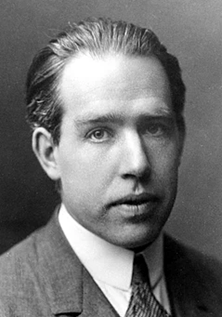
https://en.wikipedia.org/wiki/Niels_Bohr
Niels Henrik David Bohr (7 October 1885 – 18 November 1962) was a Danish theoretical physicist who made foundational contributions to understanding atomic structure and quantum theory, for which he received the Nobel Prize in Physics in 1922. He was also a philosopher and a promoter of scientific research.
https://en.wikipedia.org/wiki/Werner_Heisenberg
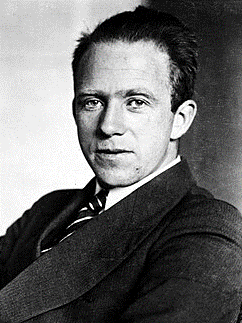
Werner Karl Heisenberg (5 December 1901 – 1 February 1976) was a German theoretical physicist, one of the main pioneers of the theory of quantum mechanics, and a principal scientist in the German nuclear program during World War II.
Before the start of World War II, Bohr and Heisenberg had been friends and colleagues. From 17 September 1924 to 1 May 1925, under an International Education Board Rockefeller Foundation fellowship, Heisenberg went to do research with Bohr, who was director of the Institute of Theoretical Physics at the University of Copenhagen.
Bohr was considered to be the father of modern atomic physics. Personally, I would disagree with this as I think the work done by J. J. Thompson and Ernest Rutherford began the process of discovering the structure of the atom.
https://en.wikipedia.org/wiki/J._J._Thomson
Sir Joseph John Thomson (18 December 1856 – 30 August 1940) was a British physicist. He received the 1906 Nobel Prize in Physics “in recognition of the great merits of his theoretical and experimental investigations on the conduction of electricity by gases.” In 1897, he showed that cathode rays were composed of previously unknown negatively charged particles (now called electrons), which he calculated must have bodies much smaller than atoms and a very large charge-to-mass ratio. The electron was the first subatomic particle to be discovered.
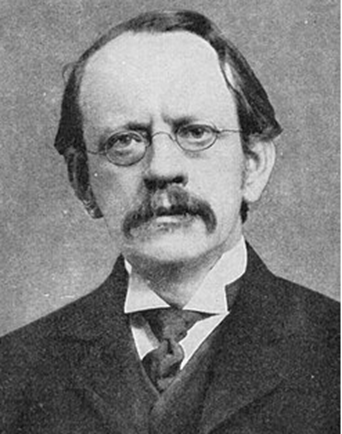
https://en.wikipedia.org/wiki/J._J._Thomson#Discovery_of_the_electron
Thompson was able to show that an atom could be “broken up”. He was only wrong about how the atom was structured. He believed that an atom was built like a plum pudding, in that the negatively charged electrons were fitted in between positive particles inside the atom, like dried fruit inside a sponge pudding.
https://en.wikipedia.org/wiki/Plum_pudding_model
It was one of Thompson’s students who took the structure of the atom a stage further.
https://en.wikipedia.org/wiki/Ernest_Rutherford
Ernest Rutherford, 1st Baron Rutherford of Nelson (30 August 1871 – 19 October 1937), was a New Zealand physicist and chemist who was a pioneering researcher in both atomic and nuclear physics. He has been described as “the father of nuclear physics” and “the greatest experimentalist since Michael Faraday.” In 1908, he was awarded the Nobel Prize in Chemistry “for his investigations into the disintegration of the elements, and the chemistry of radioactive substances. He wasn’t terribly happy about this because he viewed himself as a physicist. He stated, “All science is either physics or stamp collecting”.
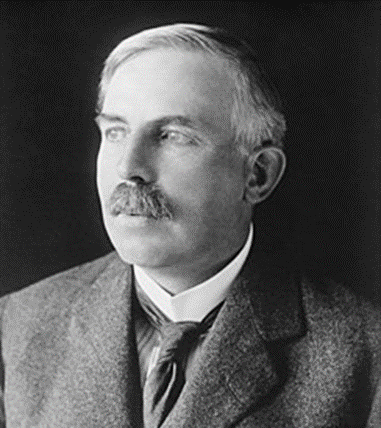
https://www.azquotes.com/author/12817-Ernest_Rutherford
Under Rutherford’s direction in 1909 Hans Geiger and Ernest Marsden performed the Geiger–Marsden experiment, which demonstrated the nuclear nature of atoms by measuring the deflection of alpha particles passing through a thin gold foil.
https://en.wikipedia.org/wiki/Hans_Geiger (below left)
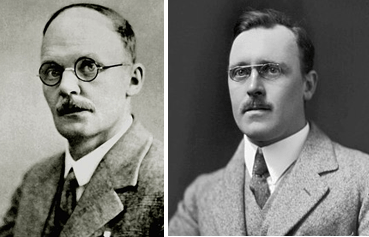
https://en.wikipedia.org/wiki/Ernest_Marsden (above right)
https://en.wikipedia.org/wiki/Rutherford_scattering_experiments#Rutherford_scattering
If Thompson’s view of the atom was correct, then positively charged alpha particles would be expected to just pass straight through the atom, as shown below.
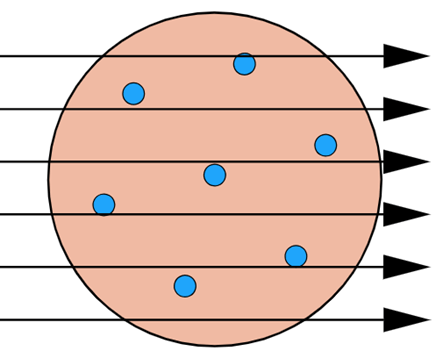
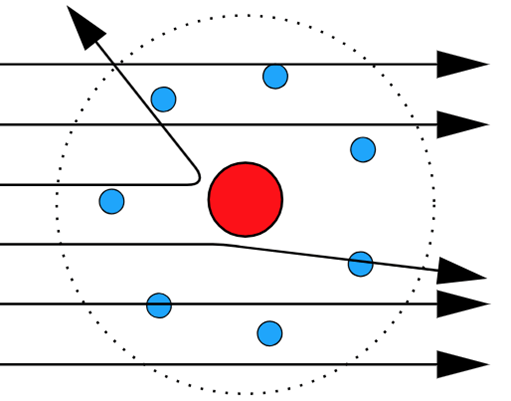
In fact, it was observed that some of the alpha particles were deflected at very large angles.
Rutherford was quoted as saying: “It was quite the most incredible event that has ever happened to me in my life. It was almost as incredible as if you fired a 15-inch shell at a piece of tissue paper and it came back and hit you.” It was Rutherford’s interpretation of this data that led him to propose the nucleus, a very small, positively charged region containing much of the atom’s mass. A diagram is shown below, but it is not to scale. In reality, the nucleus is vastly smaller, and the electrons are much further, relatively, from the nucleus.
In 1912, Rutherford was joined by Bohr (who postulated that electrons moved in specific orbits about the compact nucleus). Bohr adapted Rutherford’s nuclear structure to be consistent with Max Planck’s quantum hypothesis. The resulting Bohr model was the basis for quantum mechanical atomic physics of Heisenberg, which remains valid today.
https://en.wikipedia.org/wiki/Max_Planck
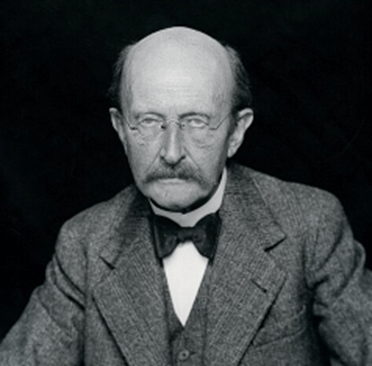
Max Karl Ernst Ludwig Planck (23 April 1858 – 4 October 1947) was a German theoretical physicist. He won the 1918 Nobel Prize in Physics “for the services he rendered to the advancement of physics by his discovery of energy quanta.”
The quantum hypothesis postulates that light energy can only be emitted and absorbed in discrete bundles called quanta.
https://en.wikipedia.org/wiki/Bohr_model
In atomic physics, the Bohr model or Rutherford–Bohr model is an obsolete model of the atom that incorporated some early quantum concepts. Developed from 1911 to 1918 by Niels Bohr and building on Ernest Rutherford’s discovery of the atom’s nucleus, it supplanted the plum pudding model of J. J. Thomson, only to be replaced by the quantum atomic model in the 1920s. It consists of a small, dense atomic nucleus surrounded by orbiting electrons. It is analogous to the structure of the Solar System, but with attraction provided by electrostatic force rather than gravity, and with the electron energies quantised (assuming only discrete values).
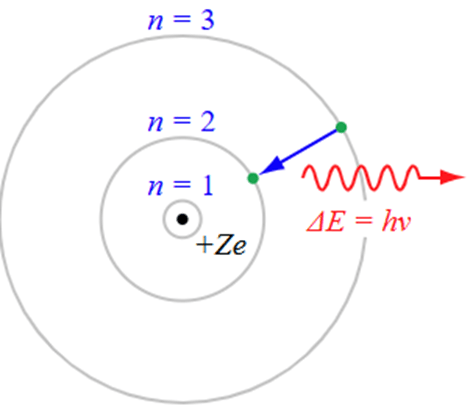
The Bohr model of the hydrogen atom (Z = 1) or a hydrogen-like ion (Z > 1), where the negatively charged electron confined to an atomic shell encircles a small, positively charged atomic nucleus and where an electron jumps between orbits, is accompanied by an emitted or absorbed amount of electromagnetic energy (hν). The orbits in which the electron may travel are shown as grey circles; their radius increases as n2, where n is the principal quantum number. The 3 → 2 transition depicted here produces the first line of the Balmer series, and for hydrogen (Z = 1), it results in a photon of wavelength 656 nm (red light). Z is the number of protons in the nucleus, and n represents the orbit that an electron is allowed. The +e indicated a positive charge.
From his work on radioactivity, Rutherford realised that atoms, once thought indestructible, could be broken up, but he believed that the amount of energy released during the process was so small as not to be useful and left it to others who found that this was not the case.
In 1919, Rutherford became Cavendish Professor of Physics at Cambridge University. During his tenure, Nobel prizes were awarded to James Chadwick for discovering the neutron (in 1932) and John Cockcroft and Ernest Walton for an experiment that was to be known as “splitting the atom” using a particle accelerator.
https://en.wikipedia.org/wiki/Cavendish_Professor_of_Physics
The picture of the atom was now a nucleus consisting of positive protons and neutral neutrons with negative electrons orbiting the nucleus, and the atoms could be broken up.
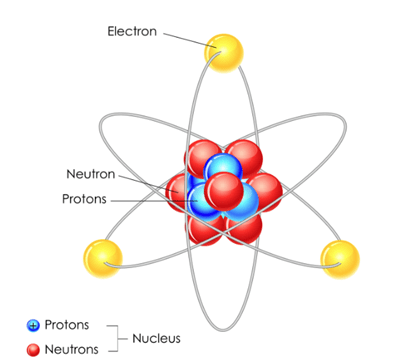
Planetary models of atoms were not new, but Bohr’s treatment was. Taking a 1912 paper that explained the on the role of electrons in the interaction of alpha particles with a nucleus as his starting point, he advanced the theory of electrons travelling in orbits of quantised “stationary states” around the atom’s nucleus in order to stabilise the atom, but it wasn’t until his 1921 paper that he showed that the chemical properties of each element were largely determined by the number of electrons in the outer orbits of its atoms. He introduced the idea that an electron could drop from a higher-energy orbit to a lower one, in the process emitting a quantum of discrete energy. This became a basis for what is now known as the old quantum theory.
The Bohr model worked well for hydrogen and ionised single-electron helium, which impressed Einstein but could not explain more complex elements. By 1919, Bohr was moving away from the idea that electrons orbited the nucleus.
An important development came in 1924 with Wolfgang Pauli’s discovery of the Pauli exclusion principle, which put Bohr’s models on a firm theoretical footing.
In quantum mechanics, the Pauli exclusion principle states, in simple terms, that two or more identical particles cannot simultaneously occupy the same quantum state within a system that obeys the laws of quantum mechanics. This principle was formulated by Austrian physicist Wolfgang Pauli in 1925 for electrons, and later extended to other particles.
https://en.wikipedia.org/wiki/Wolfgang_Pauli
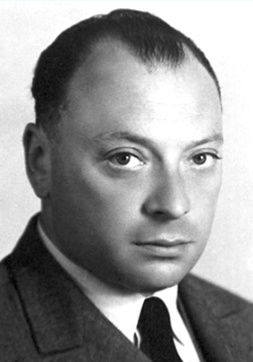
Wolfgang Ernst Pauli (25 April 1900 – 15 December 1958) was an Austrian–Swiss theoretical physicist and a pioneer of quantum mechanics.
In 1922, Bohr was awarded the Nobel Prize in Physics “for his services in the investigation of the structure of atoms and of the radiation emanating from them”
For his Nobel lecture, Bohr gave his audience a comprehensive survey of what was then known about the structure of the atom, including the correspondence principle, which he had formulated. This states that the behaviour of systems described by quantum theory reproduces classical physics in the limit of large quantum numbers.
The discovery of Compton scattering in 1923 convinced most physicists that light was composed of photons and that energy and momentum were conserved in collisions between electrons and photons.
https://en.wikipedia.org/wiki/Compton_scattering
Modelling atomic behaviour under incident electromagnetic radiation led to the development of matrix mechanics, the first form of modern quantum mechanics.
https://en.wikipedia.org/wiki/Quantum_mechanics
Quantum mechanics is the fundamental physical theory that describes the behaviour of matter and of light; its unusual characteristics typically occur at and below the scale of atoms. Basically, light can have particle properties (photons), and matter (i.e. electrons) can have wave properties.
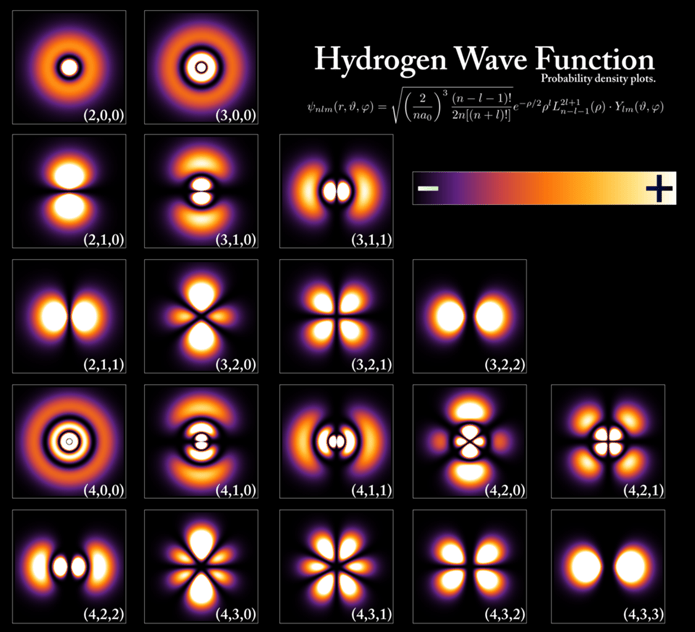
Wave functions of the electron in a hydrogen atom at different energy levels. Quantum mechanics cannot predict the exact location of a particle in space, only the probability of finding it at different locations. The brighter areas represent a higher probability of finding the electron.
It was during his stay with Bohr in 1924 that Heisenberg continued to work on quantum mechanics, and it was in Copenhagen in 1927 that Heisenberg developed his uncertainty principle, while working on the mathematical foundations of quantum mechanics. It is a fundamental concept in quantum mechanics.
https://en.wikipedia.org/wiki/Uncertainty_principle
It states that there is a limit to the precision with which certain pairs of physical properties, such as position and momentum, can be simultaneously known. In other words, the more accurately one property is measured, the less accurately the other property can be known.
Bohr became convinced that light behaved like both waves and particles, and, in 1927, experiments confirmed the de Broglie hypothesis that matter (like electrons) also behaved like waves. He conceived the philosophical principle of complementarity: that items could have apparently mutually exclusive properties, such as being a wave or a stream of particles, depending on the experimental framework.
https://en.wikipedia.org/wiki/Louis_de_Broglie
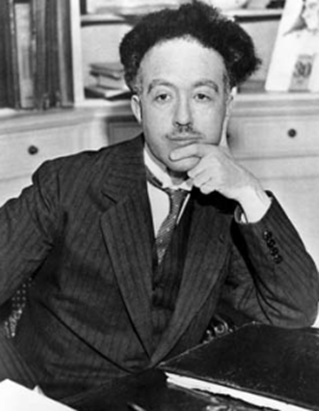
Louis Victor Pierre Raymond, 7th Duc de Broglie (15 August 1892 – 19 March 1987) was a French theoretical physicist and aristocrat known for his contributions to quantum theory.
Shortly after the discovery of the neutron by James Chadwick in 1932, Heisenberg submitted the first of three papers on his neutron-proton model of the nucleus.
https://en.wikipedia.org/wiki/James_Chadwick
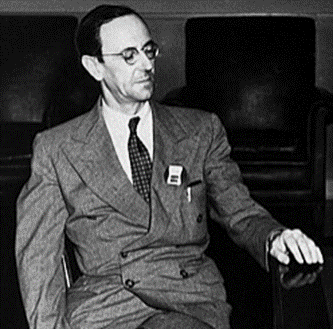
Sir James Chadwick (20 October 1891 – 24 July 1974) was a British experimental physicist who received the Nobel Prize in Physics in 1935 for his discovery of the neutron.
In 1933, Adolf Hitler came to power in Germany. He considered quantum physics and relativity to be Jewish physics, as a lot of people working on these happened to be Jewish. This led to an exodus of scientists to the UK and the US. Heisenberg remained behind.
The discovery of nuclear fission by Otto Hahn in December 1938 (and its theoretical explanation by Lise Meitner) generated intense interest among physicists.
https://en.wikipedia.org/wiki/Discovery_of_nuclear_fission
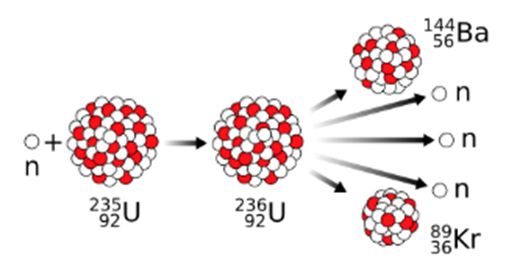
The nuclear reaction theorised by Meitner, with the following nuclear chain reaction, theorised by Hahn.
https://en.wikipedia.org/wiki/Otto_Hahn (Below left)
Otto Hahn (8 March 1879 – 28 July 1968) was a German chemist who was a pioneer in the field of radiochemistry. He is referred to as the father of nuclear chemistry and the discoverer of nuclear fission, the science behind nuclear reactors and nuclear weapons.
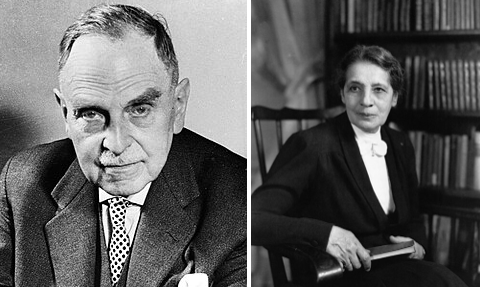
https://en.wikipedia.org/wiki/Lise_Meitner (above right)
Elise “Lise” Meitner (7 November 1878 – 27 October 1968) was an Austrian and Swedish nuclear physicist who was instrumental in the discovery of nuclear fission.
Uranium has several isotopes, in that it’s atoms can have different numbers of neutrons in their nuclei. Bohr realised that it was the uranium-235 isotope and not the more abundant uranium-238 that was primarily responsible for fission with thermal neutrons. Uranium-238 has three more neutrons than Uranium-235.
Bohr, along with John Wheeler, developed a theoretical treatment, which they published in a September 1939 paper on “The Mechanism of Nuclear Fission”. However, Bohr did not believe the process was viable because there was so little uranium-235 available, and uranium-238 slows down neutrons and absorbs them. To make an explosion, uranium-235 would have to be separated out, requiring a great deal of uranium ore.
https://en.wikipedia.org/wiki/John_Archibald_Wheeler
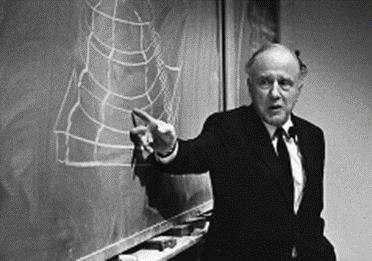
John Archibald Wheeler (July 9, 1911 – April 13, 2008) was an American theoretical physicist.
The German nuclear weapons program, known as Uranverein, was formed on 1 September 1939, the day World War II began in Europe.
In April 1940, early in the Second World War, Nazi Germany invaded and occupied Denmark. Bohr continued working, but all the foreign scholars departed.
At a scientific conference on 26–28 February 1942 at the Kaiser Wilhelm Institute for Physics, called by the Army Weapons Office, Heisenberg presented a lecture to Reich officials on energy acquisition from nuclear fission. In the lecture, he spoke of the enormous energy potential of nuclear fission. He stressed that pure U-235 had to be obtained to achieve a chain reaction.
He explored various ways of obtaining isotope 235 in its pure form, including uranium enrichment and an alternative layered method of normal uranium and a moderator in a machine. This machine, he noted, could be used in practical ways to fuel vehicles, ships and submarines. Heisenberg stressed the importance of the Army Weapons Office’s financial and material support for this scientific endeavour.
In Michael Frayn’s play, it is suggested that Heisenberg visits Bohr in 1941 to ask his opinion on whether nuclear weapons are possible.
On 4 June 1942, Heisenberg was summoned to report to Germany’s Minister of Armaments on the prospects for converting the Uranverein’s research toward developing nuclear weapons. During the meeting, Heisenberg told Speer that a bomb could not be built before 1945, because it would require significant monetary resources and number of personnel.
After the Uranverein project was placed under the leadership of the Reich Research Council, it focused on nuclear power production and thus maintained its importance for the war effort; funding, therefore, continued from the military. The nuclear power project was broken down into the following main areas: uranium and heavy water production, uranium isotope separation and the uranium nuclear reactor. The project was then essentially split up between a number of institutes, where the directors dominated the research and set their own research agendas. The point in 1942, when the army relinquished its control of the German nuclear weapons program, was the zenith of the project relative to the number of personnel. After 1942, the number of scientists working on applied nuclear fission diminished dramatically. Many of the scientists not working with the main institutes stopped working on nuclear fission and devoted their efforts to more pressing war-related work.
Hitler cancelled any research that did not produce immediate results, just at the point Heisenberg got the first sign the reactor might work with a 13% increase in neutrons. The Americans were only just ahead at this time. Heisenberg did ask for funds to continue, but the RAF had started terror-bombing German cities.
In September 1943, word reached Bohr and his brother Harald that the Nazis considered their family to be Jewish, since their mother was Jewish, and that they were therefore in danger of being arrested. The Danish resistance helped Bohr and his wife escape by sea to Sweden on 29 September. When he arrived in Britain, he was astonished at the amount of progress that had been made in developing nuclear weapons.
On 8 December 1943, Bohr arrived in Washington, D.C., where he met with the director of the Manhattan Project.
https://en.wikipedia.org/wiki/Manhattan_Project
The Manhattan Project was a research and development program undertaken during World War II to produce the first nuclear weapons. It was led by the United States in collaboration with the United Kingdom and Canada. The Manhattan Project employed nearly 130,000 people at its peak and cost nearly US$2 billion (equivalent to about $28 billion in 2024).
Robert Oppenheimer credited Bohr with acting “as a scientific father figure to the younger men” on the team. Bohr is quoted as saying, “They didn’t need my help in making the atom bomb.” Oppenheimer gave Bohr credit for an important contribution to the work on modulated neutron initiators. “This device remained a stubborn puzzle”, Oppenheimer noted, “but in early February 1945 Niels Bohr clarified what had to be done”
https://en.wikipedia.org/wiki/J._Robert_Oppenheimer
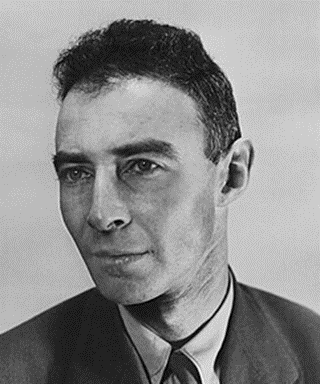
J. Robert Oppenheimer (born Julius Robert Oppenheimer, April 22, 1904 – February 18, 1967) was an American theoretical physicist who served as the director of the Manhattan Project’s Los Alamos Laboratory during World War II. He is often called the “father of the atomic bomb” for his role in overseeing the development of the first nuclear weapons.
https://en.wikipedia.org/wiki/Alsos_Mission
The Alsos Mission was an organised effort by a team of British and United States military, scientific, and intelligence personnel to discover enemy scientific developments during World War II. Its chief focus was to investigate the progress that Germany was making in the area of nuclear technology, and to seize any German nuclear resources that would either be of use to the Manhattan Project or worth denying to the Soviet Union.
On 30 March 1945, the Alsos Mission reached Heidelberg, where important scientists were captured. Heisenberg was sent to join them. He was flown to England on the 3rd July 1945.
Nine of the prominent German scientists who published reports in Nuclear Physics Research Reports as members of the Uranverein were captured by Operation Alsos and incarcerated in England under Operation Epsilon. Ten German scientists, including Heisenberg, were held at Farm Hall at Godmanchester in England. The facility had been a safe house of the British foreign intelligence, MI6. During their detention, their conversations were recorded. Conversations thought to be of intelligence value were transcribed and translated into English. The transcripts were released in 1992. On 6 August 1945, the scientists at Farm Hall learned from media reports that the US had dropped an atomic bomb in Hiroshima, Japan. At first, there was disbelief that a bomb had been built and dropped. In the weeks that followed, the German scientists discussed how the United States might have built the bomb.
The Farm Hall transcripts reveal that Heisenberg, along with other physicists interned at Farm Hall, including Otto Hahn, were glad the Allies had won World War II. The transcripts were used in a play, Farm Hall, by Katherine M. Moar.
https://en.wikipedia.org/wiki/Operation_Epsilon
Operation Epsilon was the codename of a program in which Allied forces, near the end of World War II, detained ten German scientists who were thought to have worked on Nazi Germany’s nuclear program.
On the failure of the German nuclear weapons program to build an atomic bomb, Heisenberg remarked, “We wouldn’t have had the moral courage to recommend to the government in the spring of 1942 that they should employ 120,000 men just for building the thing up.”
In 1992, the transcripts were declassified. Heisenberg was heard to admit that he had never calculated the critical mass of an atomic bomb before. When he subsequently attempted to calculate the mass, he made serious calculation errors.
Heisenberg returned to Germany in 1946 and continued his research. In 1951, he agreed to become the scientific representative of the Federal Republic of Germany at the UNESCO conference, with the aim of establishing a European laboratory for nuclear physics.
Heisenberg’s aim was to build a large particle accelerator, drawing on the resources and technical skills of scientists across the Western Bloc. On 1 July 1953, Heisenberg signed the convention that established CERN on behalf of the Federal Republic of Germany. Although he was asked to become CERN’s founding scientific director, he declined. Instead, he was appointed chair of CERN’s science policy committee and went on to determine the scientific program at CERN.
https://en.wikipedia.org/wiki/CERN
In his late sixties, Heisenberg penned his autobiography for the mass market. In 1969, the book was published in Germany; in early 1971, it was published in English and in the years thereafter in a string of other languages.
Heisenberg wrote his memoirs as a chain of conversations, covering the course of his life. The book became a popular success, but was regarded as troublesome by historians of science.
Heisenberg died of kidney cancer at his home on 1 February 1976.
Following the end of the war, Bohr returned to Copenhagen on 25 August 1945 and was re-elected President of the Royal Danish Academy of Arts and Sciences on 21 September. He pledged his support to CERN in February 1952, and Geneva was chosen as the site in October.
It was said of Bohr, “There were other personalities who started and conceived the idea of CERN. The enthusiasm and ideas of the other people would not have been enough, however, if a man of his stature had not supported it.”
Bohr died of heart failure on 18 November 1962 at his home in Carlsberg, Copenhagen.
So, what did Bohr and Heisenberg discuss during Heisenberg’s visit in 1941? This is what I think Michael Frayn was suggesting.
1) Heisenberg asked Bohr if a physicist has the moral right to work on the practical exploitation of atomic energy.
2) That Bohr was horrified that Heisenberg could actually be working on it to produce nuclear weapons.
3) That Heisenberg was only considering it as a method of generating electricity.
4) Bohr felt that there wasn’t enough U235 to make nuclear weapons and that U238 would absorb fast neutrons, preventing a chain reaction.
5) Heisenberg suggested a final product of U238 absorbing fast neutrons would be plutonium. As something at least as fissile as U235.
6) That Heisenberg tried to pick Bohr’s brain about nuclear fission.
7) That Heisenberg tried to find out if Bohr knew anything about the Allied nuclear programme.
8) Heisenberg tried to persuade Bohr to work on the German nuclear programme.
9) That Heisenberg tried to reassure Bohr that there was no German nuclear programme.
10) Bohr tried to placate Heisenberg by saying that everyone in wartime is obliged to do their best for their country.
11) Bohr told Heisenberg and his colleagues not to work on Germany’s nuclear programme.
12) Heisenberg explained that if he didn’t work on the German nuclear programme, other, more pro-Nazi scientists would. Heisenberg could keep the nazis out.
13) Bohr suggested to Heisenberg that he tell the nazis that nuclear weapons would require an enormous technical effort and use huge resources to discourage them.
14) Heisenberg asked Bohr if the Americans were working on an atomic bomb.
15) Heisenberg asked Bohr to ask the Americans to stop work on the nuclear programme.
16) Bohr told Heisenberg that he had no contact with the Americans.
17) Heisenberg explaining he only mentioned plutonium to the nazi to keep other nazi scientists away.
18) Reminiscing about Heisenberg’s previous visits to Copenhagen.
19) That Heisenberg wanted to brag about being in charge of important research.
In the play, it is implied that there were other meetings between Bohr and Heisenberg. During these, I believe Michael Frayn is suggesting:
1) Heisenberg asked if Oppenheimer was planning on dropping the bomb on Germany, as Oppenheimer was heard to say he was disappointed that the bomb hadn’t been ready to use on Germany.
2) Bohr explained that the use of the bomb had tormented Oppenheimer afterwards.
3) Heisenberg describes the effect of all the conventional bombs dropped on the German cities, and how people are starving.
4) Heisenberg describes his time at Hall Farm after the war, and his reaction to nuclear bombs dropping on Japan.
5) Bohr explained he had very little to do with the American nuclear programme. He simply put forward a suggestion on how to trigger the Nagasaki bomb.
6) Heisenberg complained that in 1949, physicists who worked on the Manhattan Project refused to shake his hand.
7) Heisenberg explained that he didn’t tell anyone about plutonium because there wasn’t enough money to keep the reactor going. That he moved his reactor across Germany to protect it and keep it out of the way of nazis and bombs.
8) Bohr explained that the reactor couldn’t be used because there were no control rods to absorb excess neutrons to slow down the reaction when it overheated. Heisenberg believed the reaction would’ve been self-limiting, when it wasn’t.
9) Heisenberg explained that he had managed to produce a fantastic neutron growth and Bohr saying that it was thanks to the Allies that he was saved from suffering if the reactor had gone critical, and that the Americans were at least two years ahead with their programme.
10) Heisenberg wondered if it would have been better to have died so as not to suffer thirty years of reproach and hostility.
11) Bohr was wondering if Heisenberg didn’t discuss plutonium because he was worried what would happen if the nazis committed huge resources to the programme and it failed. Or perhaps he simply didn’t understand the physics, or got the maths wrong.
12) Bohr pointed out that the Americans did the right calculations because some of those involved were German Jews. Germany had lost out because it didn’t believe in “Jewish Physics”.
Of course, in reality, the only people who really know what went on during the various meetings are Bohr and Heisenberg themselves. After the war, Heisenberg was heard to say that he deliberately hampered German research into nuclear weapons. Apparently, Bohr was so angry about this that he drafted letters to Heisenberg, which he never sent. These were found amongst his effects when he died.
https://en.wikipedia.org/wiki/Michael_Frayn
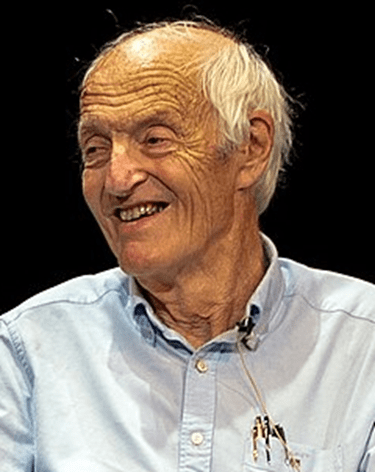
Michael Frayn, FRSL (born 8 September 1933) is an English playwright and novelist.


